Saturday, March 12, 2016

Fishing

Recently, a customer commented that he loved our store because it reminded him of a fishing-supply store...lots of gear and little specialized tools.

It reminded me of something Michael Cardew had said about the creative process..."It's as if you are fishing for big, mysterious fish. You have to be careful what your net is made of and how you set it out. So, in your art, you ask yourself, if I go about it in this way...am I going to catch the fish?"

Sometimes you might catch a good painting. Other times, your catch might be a new effect, skill or technique. 
But, if you're painting on location, in the moment, on-the-spot, you're practically assured that you will come away with a heightened awareness and something new and fresh.

In a recent interview, Bill Watterson explained why he doesn't sell his paintings:
"It's all catch and release...just little fish that aren't worth cleaning and cooking."

Tuesday, October 06, 2015

Explaining the Composition Finder

Sometimes people wonder about the little charts & diagrams on the Guerrilla Painter Composition Finder. Here are some explanations:
 
The Golden Section and Fibonacci Spiral
Leonardo Pisano Fibonacci was a 13th century mathematician who is known, among many other things, for the Golden Section and Fibonacci Spiral. These are closely related mathematically to familiar forms in nature, such as the arrangement of flower petals, seed-heads and pine cones, the shell of the chambered nautilus, all the way up to hurricanes and galaxies.
Color Complements
On the front of the Composition Finder™ is a simple color complement guide, which can be a useful reminder when mixing grays and browns. The colors are not exactly accurate, particularly the purple complement of yellow. Many painters, however, find this slightly reddish purple more useful in mixtures with yellow than its true complement, which is more bluish.
The Golden Section describes a rectangle of particularly pleasing proportions, with sides having a ratio of 1 to 1.618. Examples of the use of similar proportions are found throughout art and architecture from the most ancient times to the modern. From the Renaissance on, many painters have used the Golden Section to create compositions and locate focal points within those compositions.
The “Golden Intersection
On the back of the Composition Finder™ is an illustration of the Golden Section and Fibonacci Spiral. Painting sizes that approximate the Golden Section are indicated. The Golden “Intersection” (considered by some to be a promising focal point for a composition using the Golden Section) can be found where the horizontal and vertical lines connecting the diamonds intersect.
Trust Your Visual Intuition
Truisms to the contrary, there are no hard and fast rules that govern compositions. Good painters seem to break one or more of “the rules” as often as not. Consider throwing all the rules “out the window” of the Composition Finder™ and just trust your visual intuition. As you survey your subject through the Composition Finder™, you will see how the visual interest changes as you move it across the scene before you. With a little practice, you will know instinctively when you’ve found the best composition for you.

Wednesday, February 04, 2015

Green

We recently watched a course about the effects of color. This is a topic that has actually been well researched, but I was a little disappointed that they didn't include orange or purple, and they didn't say anything about the various intensities. It was limited to black, white, red, yellow, blue and green. 
There are often conflicting effects, such as yellow indicating both happiness and caution, and blue symbolizing both friendliness and depression. 
One of the more interesting conclusions was that the color green enhanced creativity. The experiment involved asking people to come up with as many unconventional ways to use a brick as they could think of within a certain time limit, and the subjects who were given a folder with a green cover did consistently better than those whose folder was either white, blue or red. 
Maybe all we need to do is put our composition finder inside a bright green envelope, and we'll see lots more options for what to paint ;-)

Sunday, October 12, 2014

Extreme Plein Air

en Plein Air (official trailer) from Wildman Pictures on Vimeo.

"I had to re-think what I thought about landscape painting as a trivial pursuit. It's not trivial. The land, how we live on the land, how we relate to the land...it defines us." says Kally Thurman of Outskirts Gallery in Hope, Idaho, in this film entitled Extreme Plein Air
 The entire 20-minute film can be seen here on Vimeo. It features artists Jaren Shear and Aaron Cordell Johnson. It also features close-ups of *real mountain goats* ;-)

Friday, September 26, 2014

This is your brain on plein air painting...

Earlier this week I had some errands to run in Denver, about 100 miles away. As I was driving home in stop-and-go traffic, feeling an impractical combination of tired and anxious at the same time, I happened to notice the sun coming through the clouds and landing in a bright patch on the foothills, which were green from the recent rains. 
I felt my brain relax and expand, and I took a breath. Ahhh, that's the bonus for a plein air painter...awareness beyond the ordinary. And you don't have to look far. There's usually something visually remarkable within reach. 
I came across this blog by a runner who is also a photographer, illustrating his various trails...including climbing the Flatirons in Boulder.

Thursday, December 12, 2013

Cleaning Brushes Without Solvents

There is a helpful post at the Williamsburg Oils Blog about cleaning brushes without using solvents. People are becoming more aware about the toxicity of turpentine and mineral spirits. Even the low-odor type can be harmful if not used with plenty of ventilation.

The comments section also contains some good suggestions. After wiping your brush well on a rag or paper towel, you can use either Goop hand cleaner, baby oil or safflower oil from the grocery store to remove the residual paint. Then soap & water (regular bar soap or Murphy's Oil Soap) will finish the job. Maybe top it off with Master's or Winsor-Newton Brush Cleaner.

There is also a post by Larry Seiler on WetCanvas! where he describes how to melt down Ivory soap. He uses it as an inexpensive alternative for cleaning brushes in the classroom.

Of course, Gamblin Gamsol is a reasonably safe solvent, made from cosmetic grade petroleum distillate with all harmful aromatic solvents refined out of it, so it is minimally toxic whether inhaled, ingested or exposed to skin. It is good for thinning oil paints and mediums as well as cleanup.

And this new YouTube video from Rublev Colours (aka Natural Pigments)

Monday, October 28, 2013

Autumn Leaves

I always thought that one of the best things that Art could do was to turn sadness into beauty. 
Alchemy. 
That kept me going for a long time, but as I start to get old I realize that everything beautiful eventually turns into sadness.

I sort of knew this all along, of course. Mark Twain told me so. But it's one thing to have someone (even a very wise man) tell you something, and another thing to experience it.

 Then I remembered the Navajo Beautyway chant:

In beauty may I walk

All day long may I walk

Through the returning seasons may I walk

...and I remembered that beauty is much larger, more powerful than anything in the human world.

With beauty before me may I walk

With beauty behind me may I walk

With beauty above me may I walk

With beauty all around me may I walk

In old age, wandering on a trail of beauty, lively, may I walk

In old age, wandering on a trail of beauty, living again, may I walk

It is finished in beauty

It is finished in beauty

Sunday, October 06, 2013

Robert Bateman Talks Art at 2013 SKB Workshop


Thank you to Gayle Crites for telling me about this Robert Bateman video interview last night.

It was recorded at the Susan K Black Foundation last month.

"I think the world would be a better place if everybody was a plein air painter. Not so much to do with art, but with paying attention to a place." The new Robert Bateman Centre is now open in Victoria, BC Canada.

Sunday, June 09, 2013

Fire & Water

Yesterday, the Guerrilla Painter, his sister Becky and I participated as designated plein air painters in the annual open house for the Fort Collins Waterworks. This historic facility was first proposed in 1880, and the first part was built in 1883.

There were displays showing the results of  an excavation, explanations of how the pumps were powered by water pressure, and volunteers teaching about how ditches were dug in the 19th century, using horses.

  The motivating factor for the pioneers back in 1880 was to have enough water (and water pressure) to fight fire. Modern firemen and their firetrucks were on hand at this event yesterday, and it was a solemn reminder of the destructive High Park wildfire that began one year ago today. Although we weren't directly affected, it was so close. The hills are black. Many friends were evacuated, some lost their homes, and one friend was killed.

This is Becky's pastel from the morning of June 9, 2012. We were out painting and we spotted a tiny wisp of smoke on the horizon.

Saturday, July 14, 2012

The High Park Fire

Thank you to the many customers who expressed concern about our proximity to the recent High Park Fire, ignited by a lightening strike in the early morning of June 9. After burning over 87,000 acres and destroying 259 homes, it continues to smolder in spite of the 2.5" of rain that fell last week.

We'd like to express our condolences to the family of Linda Steadman, who was killed in her hundred-year-old cabin on the Steadman Ranch as the winds whipped the flames through the dry timber.

And special thanks to Genevieve Baud Caizergues, who wrote to us from southern France. Her village had to be evacuated in August, 2010, when wildfires burned over 7,000 acres of vineyards, pine and oak woods. She took her neighbor's girls and their 2 cats, her dog, 2 cats and 2 tortoises (!) in her Volkswagen camper.

She reminded us of a quote... "Giacometti said: 'In a fire, between a Rembrandt painting and a cat, I would save the cat.' "

Friday, January 13, 2012

Creative Map from Fast Company


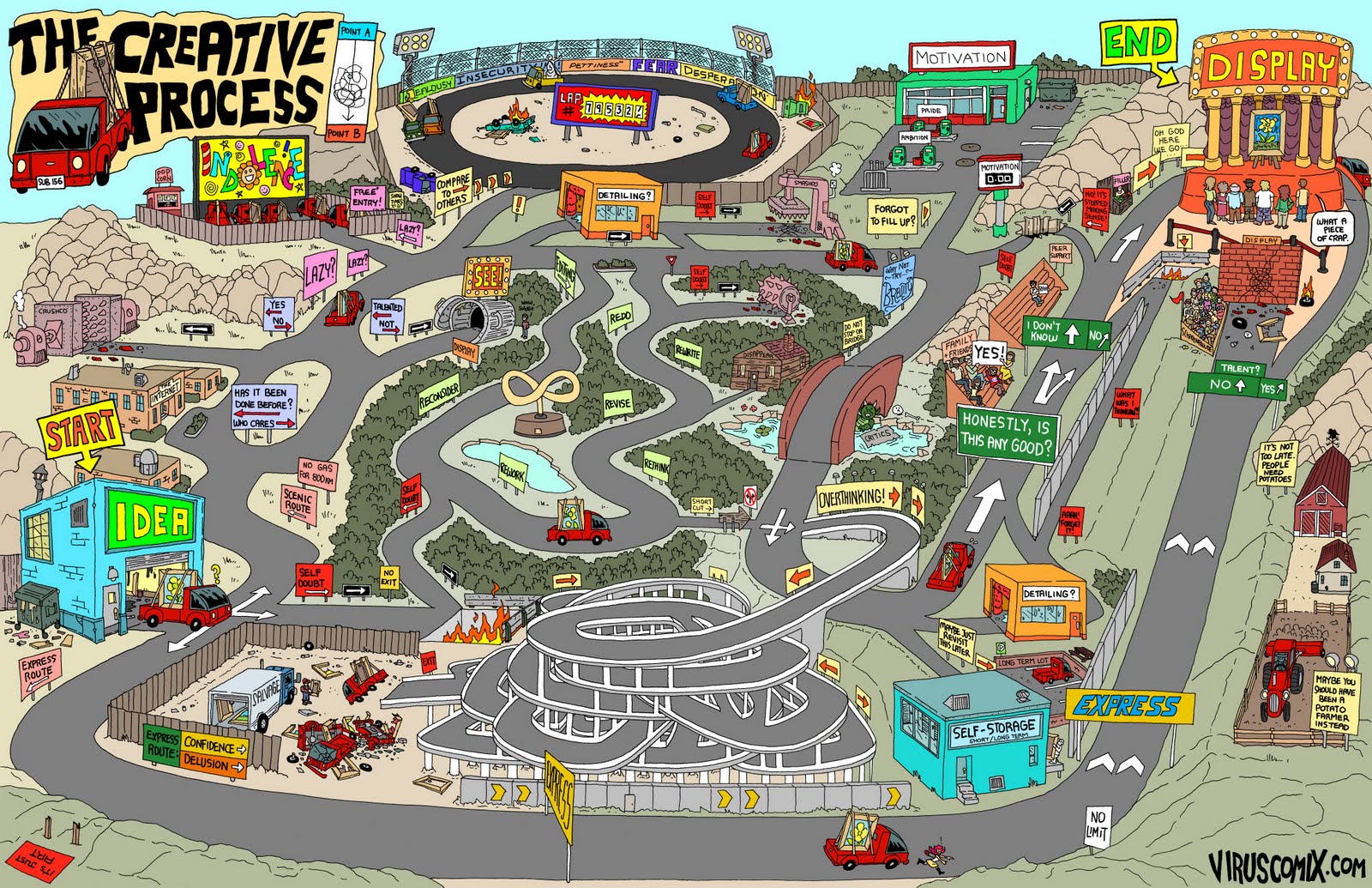
This is a link to an amusing graphic about the creative process, from Start to Display, with every possible distraction and complication along the way. From "Has it been done before?" past "Lazy" and the lap track of "Compare to Others" through "Detailing" and the "Motivation Filling Station." There's always the option of "Self Storage" (short or long-term) or a log cabin to disappear into. Watch out for the critics under the bridge, and be thankful for family and friends in the bleachers.

Zoom in to make it big enough to read the signs...

Wednesday, November 23, 2011

The Art of Urban Sketching

Urban Sketchers is a nonprofit, international organization dedicated to promoting awareness of the value of location drawing. It is open to anyone who draws on location and can show a regularly updated body of work online.

They have a new book coming out in February which is both a guide and showcase of their diverse membership. It incluldes sketches and observations from more than 50 cities in more than 30 countries around the world. You'll find more than 600 beautiful illustrations, as well as artists' profiles and extended captions where these urban sketchers share their stories, how they work, sketching tips, and the tools behind each drawing.

The author, Gabriel Campanario, is a staff artist at The Seattle Times and the founder of Urban Sketchers. Campanario’s newspaper column, Seattle Sketcher, was awarded first place for blog writing in “The Best of the West” journalism contest.

This 320-page book can be pre-ordered at Amazon.

Wednesday, August 31, 2011

Goals

Recently I heard two completely separate radio interviewees, one a financial advisor and one a therapist working with vets returning from war, say exactly the same thing: "I ask them about their goals."

That made me wonder for the first time what goals one might have (beyond learning and having fun) for painting outdoors. (Of course, your first goal, before you even head out, is to banish the inner critic...you can just say, "Bye for now!")

On one end of the continuum, there would be air castles like "Have a significant impact the art world, paint what has never been painted before, make people see things in a new way, make a living as a painter, be a famous teacher..." For most of us, not likely to happen in this lifetime.

Then, closer to the center would be goals like "Create expressive mementos of people, places and pets; practice observing nature and creating compelling compositions; communicate a mood or perspective..." Attainable, perhaps.

At the other end would be goals that one can never fail to achieve: "Practice perspective and proportion, explore the effect of certain colors on each other and on the viewer, experiment with mixing colors, try out different kinds of brush-strokes, discover your strengths, enjoy the interplay of paint, brush, surface and vision, pay attention..." And in the process, create something absolutely unique...something else that you can never fail to do.

Of course, you might want to ask yourself, who is setting these goals, really? The real you, or the anxious ego? The marketplace, the instructor, the cohort, the client? Just being aware of all the potential static in the atmosphere can help us tune in to a clear signal.


Wednesday, July 20, 2011

A "bad day" painting is better...


We went painting in Lory State Park recently. I chose a promising spot, a little ways up a steep trail. I had to go back to the car to get something, and by the time I got set up, the light clouds had turned into a steady rain. The Guerrilla Painter had been painting (wild roses) from the car, so it didn't bother him! He was far enough along with his oil sketch that he suggested we look for a covered picnic area where I could paint and he could finish his painting from memory (and other wild roses). By the time we found a picnic area, the rain had stopped, so I decided to take a short hike up to a little waterfall. I took my good friend the Shadebuddy umbrella, just in case. The trail was steep and narrow, but I found a level spot for my chair & umbrella just in front of the waterfall and took out my mini sketchbook to compose the basics of the scene. Odd angles, abstract shapes, moving water and close values created a real challenge, and I spent more time staring rather than drawing. I realized that the stone had a grain to it that resembled water. Then the goldfinches started coming, drinking and bathing in the pool in front of me. What could I do but stare? Next, a spectacular male lazuli bunting appeared. You don't often see them, and, again, all I could do was stare. Soon it was time to go, and I hadn't even finished my sketch. From a "painting" standpoint, the afternoon was a total failure...

Monday, April 11, 2011

The Drala Mountain Center


The Drala Mountain Center, a Buddhist retreat center in the foothills of northern Colorado, is celebrating its 40th anniversary this year.

The Guerrilla Painter remembers when (back in the '70s) there was virtually nothing there. Now they have a world-class stupa, all kinds of buildings and facilities, and various classes, programs and retreats. Dalai Lama visited recently, using a helicopter to fly in from the Denver airport.

Since they offer their facilities (600 quite, beautiful acres, various lodging options at reasonable rates that include three meals a day), I've often thought that it would be a good venue for a plein air painting workshop.

Monday, February 07, 2011

Will Rogers, Art Critic

Will Rogers was a world traveler and movie star as well as a humorist.
Here is his opinion about painting, which could serve as encouragement to us all:
"When you ain't nothing else you're an artist--it's one thing you can claim to be and no one can prove you ain't."


Monday, December 06, 2010

Extreme Plein Air, Part 2: Salt Water Media


This is a page of videos showing renowned U.K. artist Kurt Jackson in action. The first film shows him sketching off the coast of Cornwall, first aboard the Greenpeace vessel Esperanza, keeping an eye on commercial bass fishermen who have been catching dolphins in their nets and killing them, next on an inflatable speedboat which approaches the trawlers to disrupt them, and finally on a more traditional line-fishing boat, which is dolphin-safe.

His paintings on solid ground are also unusual. Some are realistic, some quite abstract, and sometimes the tangled shrubs & branches are reminiscent of Jackson Pollock. He paints on a large (sometimes five feet or more) canvas spread out on the ground and held in place by rocks. He has followed rivers from their source to the sea, painting along the way (sometimes from a boulder in the middle of the stream). He makes notes on the canvas about the experience, noting the weather, wildlife, historical features, botanical species, etc. He uses various and mixed media, from watercolor, ink, oil and acrylic to collage, etching and sculpture. He has painted inside the tin mines of Cornwall and Spain.

He has donated paintings and prints to be auctioned off for the benefit of causes such as WaterAid, Friends of the Earth, Oxfam, Greenpeace, among others.

This painting is entitled Every hedge has an eye, every ditch has an ear:

Saturday, October 09, 2010

Sketchcrawl # 29 - Saturday October 16th


This page from the official SketchCrawl website has information about how easy it is to participate. This regularly-sceduled global event began back in '04.

You can view the results of past events: sketches from all over the world of architecture, people, plants & animals, food & drink, landscapes and even the sketchers themselves.

There are no rules:
-Anyone can participate, be it to draw for 20 minutes or the full day .
-Any level of ability is welcome from veteran artists to first time sketchers.
-Any age! Try it with your kids!

Wednesday, September 29, 2010

Mark Daily - Notes for Outdoor Painting


This is a page by Mark Daily, an instructor at the Art Students League of Denver, that I happend across today. It discusses his outdoor painting class and has lots of helpful information.

Here are two samples: "... doing an oil painting is like writing a novel without an editor. It's really open-ended. By comparison, doing a woodblock print forces you to make an enormous reduction of facts. You must limit yourself to JUST ENOUGH. There is tremendous value in trying to do this. If you can't get a handle on the essentials of what you are attempting to portray, your results will be very poor, without character. Our best painters are not considered great because they render details better than everyone else. They've built details upon a solid design and fine drawing...Simplicity is an important addition to your fundamental artistic understandings."

"...your artistic development should advance as your skills advance. Artistic development is the more important part because it’s the process of taking responsibility for the what and why of your subject matter. It is a difficult process because there’s no way to know for sure if things are going in the right direction, there’s no one to reassure you. Those 'what' choices are near the heart of you- what has meaning for you. Notice thoughts which inspire you. Pay attention to what you enjoy and stop to record it. Find a way to keep these mental notes on yourself from evaporating, from being lost in the shuffle. A moment, a place, an emotion, a theory, an opinion, whatever; it provides a connection to what in the future might be a painting- the bits of inspiration come from many sources. They will keep coming and they are unique to you."

Tuesday, August 31, 2010

"En "Plein Air" in the Scotchman Peaks

en Plein Air (official trailer) from Wildman Pictures on Vimeo.


You could call this "Extreme Plein Air."

Just 60 miles south of the Canadian border, Scotchman Peaks roadless area spans the Idaho-Montana border. Educational film company Wildman Pictures went there with a small group of painters to make a documentary about a five-day plein air adventure.

It should be completed and released this fall.